Príamo Ferro
La piel del tamborPríamo Ferro is the aging, uncompromising parish priest of Nuestra Señora de las Lágrimas, whose persistence keeps the threatened church in use and whose celebration of Mass gives its parishioners a refuge of consolation. Introduced as a hostile obstacle to Lorenzo Quart’s investigation, Ferro gradually emerges as more than the rigid provincial cleric described by his superiors: his history of loneliness and unanswered prayer reveals a man who has questioned belief without relinquishing his responsibility to those who still depend on it.
Identity and Background
Ferro had spent most of his priesthood in a remote village in Alto Aragón. According to Archbishop Aquilino Corvo, he served there from his twenties until he was fifty-four, watching his congregation die away one by one until he was left without a parish. He then spent ten years at Nuestra Señora de las Lágrimas. Corvo portrays him as uncultured, fanatical, reactionary, and unable to distinguish his own convictions from the world around him; the bishop particularly objects to Ferro’s disregard for pastoral directives and calls to order. That account is plainly shaped by an institutional dispute, but it also identifies the uncompromising temperament that Ferro displays when Quart arrives.
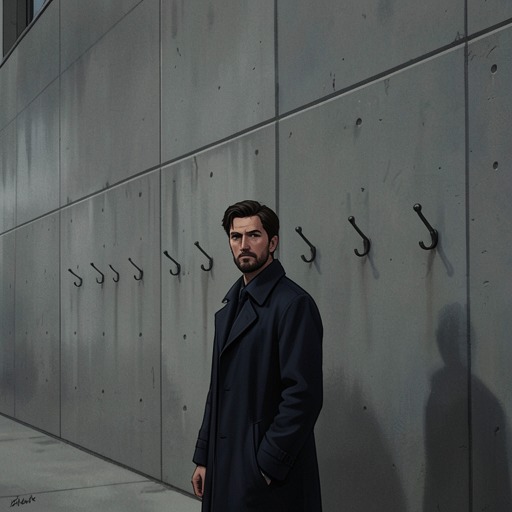
Ferro’s appearance reinforces the contrast between official dignity and material neglect. His hair is roughly cropped, his face marked by old scars, and his priestly clothes are worn: during Mass, an old, dirty cassock and unpolished shoes show beneath a faded chasuble. Yet ritual changes how he is seen. As he bends over the altar and speaks the ancient prayers, Quart recognizes that the priest’s bearing acquires an authority that his shabby clothes otherwise obscure.
The Church and Its Thursday Obligation
Ferro’s daily work has a direct legal and institutional consequence. An old privilege granted in 1687 provides that Nuestra Señora de las Lágrimas retains its rights so long as Mass is said there every Thursday for the soul of Gaspar Bruner de Lebrija, the church’s benefactor. The obligation commemorates Bruner’s death on a Thursday in 1709. Ferro does more than meet the minimum condition: he celebrates Mass every day at eight in the morning, and on Sundays and feast days he celebrates twice.
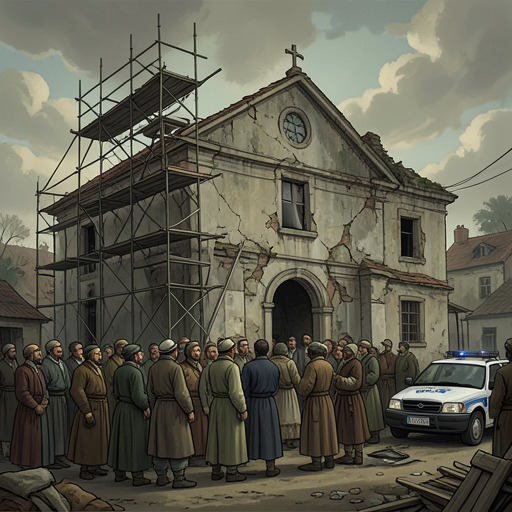
The Thursday service turns a devotional practice into a point of surveillance. An emissary of the archbishop and a notary paid by Pencho Gavira sit in the back pews, watching for an irregularity or lapse that could clear the way for the church’s secularization and demolition. The building is short of money, and its parish cannot fund the continuing repairs; Ferro and Macarena Bruner have little beyond what they need to live. Its protection therefore depends in part on the exact observance of a centuries-old condition, not simply on the authorities’ willingness to preserve it.
Quart’s Arrival and Their Changing Understanding
When Quart first approaches him in the church, Ferro is already beside him as the glare from the doorway gives way to the building’s dim interior. Quart introduces himself and offers his hand. Ferro refuses the greeting and says he has nothing to discuss with him. Quart explains that he has been sent by the Institute for External Works and presents credentials in a letter addressed to the priest by the Secretariat of State. Ferro tears the letter in two without reading it and dismisses the credentials as irrelevant.
Quart answers that the church belongs to them, not just to Ferro. The priest pauses to look at the torn pieces on the floor, then rejects Quart’s claim as well and walks away toward the sacristy. Their first encounter makes the church’s ownership and authority feel inseparable from their personal antagonism. Quart has arrived to identify the author of a message and report to Rome, while Ferro sees the emissary as an intruder whose credentials do not earn his cooperation.
Their suspicion begins to ease in the observatory, a tower of the Bruner house that once held a dovecote and was later converted into an astronomical observatory by Macarena’s grandfather, Luis Bruner. Ferro now works there, with the duchess’s permission. The room’s position between earth and sky briefly offers the two priests neutral ground. Quart recognizes a rare impulse of fellowship between them: they seem like solitary soldiers who have recognized one another amid a hostile field. The shift does not resolve their disagreements, but it makes mutual recognition possible.
Loneliness, Faith, and the Meaning of the Mass
Ferro tells Quart that, as a young priest, he read the philosophy of antiquity from Socrates to Saint Augustine, but retained little beyond a bitter-sweet sense of melancholy and disillusion. At sixty-four, he says, he knows that people remember, fear, and die. For a long time, he searched for God in the sky and wanted a direct reckoning with Him. In the isolated parish in Aragón, he watched people suffer and die while feeling forgotten by his bishop and those around him. He left his nearly empty church on Sundays to carry the last rites through snow, rain, and mud to the old people who were waiting for him to arrive and die.
For a quarter of a century, Ferro sat beside the dying as they clung to his hands because he was their only comfort. He spoke to God, he says, but never received an answer. The account complicates any easy division between a confident believer and a disbeliever. His continued ministry does not depend on a claim that he has solved the problem of suffering; it grows instead from his memory of people who needed someone to stay beside them.
Quart sees this most clearly during Mass. Despite his technical skepticism and his contempt for Ferro’s manner, he is moved by the solemnity with which the priest performs the rite. The gestures and words seem to transform the shabby, irascible country priest, giving him a momentary authority as he bends over the host and chalice. Quart’s attention shifts from the question of whether God is present to the congregation’s faces: the people watch Ferro’s hands and listen to his voice, finding in the liturgy warmth against cold and a friendly hand in darkness. In that silence, the Mass provides consolation whether or not its promise can be proved.
Ferro explains that this is why he defends the church. Whether or not he himself has faith, the people who come to him do, and their need is sufficient reason for Nuestra Señora de las Lágrimas to exist. He describes its Baroque art as a language of spectacle and passion: gilded altars and sculpted forms offer people an experience to contemplate rather than an argument to master. He warns that excessive analysis can rob them of hope, calling truth something that can kill before its time. Quart challenges the social cost of such protection, comparing the church in Ferro’s account to seventeenth-century television. Their disagreement leaves the tension intact: the parish offers real consolation, but Ferro’s defense of consolation also raises the question of whether it shields people from the truth.
Discipline, Investigation, and Narrative Role
Corvo tells Quart that he has considered suspending Ferro from his office, but that he has asked Rome to authorize the measure and the process is slow. The archbishop frames the conflict as one of discipline rather than authority: he cannot simply prevent a priest from celebrating Mass, even though Ferro ignores his pastorals. A separate institutional pressure arises from the 1687 privilege, which makes the continued Thursday Mass a practical obstacle to demolition. Church law, local custom, and the threatened property thus converge on Ferro’s routine.
Later, while discussing the investigation with Pencho Gavira and the banker Octavio Machuca, Corvo insists that Quart’s mission is to provide Rome with specialized information, not to act directly against Ferro. Quart has not gathered enough evidence to substantiate disciplinary action, and the archbishop says the local see is constrained by ecclesiastical formality. The dispute exposes how responsibility is passed between Rome, the archbishop, and the investigator, while Ferro remains the person whose daily practice holds the church’s legal protection in place.
Quart also confronts Ferro with an unresolved part of his past: a man named Francisco Montegrifo reportedly said that Ferro sold him an altarpiece from his former parish in Aragón. Ferro confirms that he remembers Montegrifo, but the supplied exchange does not establish what happened to the altarpiece or what Ferro’s account of the matter is. The allegation therefore remains a question Quart is unwilling to include in his report without hearing the priest’s version.
Ferro’s position becomes more precarious when Quart encounters a body concealed beneath blue canvas in the church confessional. The visible hand is turned palm-up and bears a wound running from the wrist to the index finger. Quart asks who the dead man is; in the subsequent conversation, the discovery raises the prospect that Ferro may be detained before Rome has received Quart’s account. Quart considers the competing demands carefully: the Church should find Ferro a good lawyer and defend his innocence until evidence proves otherwise, but if guilt is manifest, it should facilitate secular justice. The excerpts do not establish Ferro’s final fate or settle the murder investigation. They leave him suspended between the church he has defended, the authorities who have tried to discipline him, and the unanswered moral question of how far protection can go before it becomes concealment.